Over the years, I have watched learning technology solve increasingly sophisticated versions of the same problem: How do we get the right learning to the right person?
We moved from catalogs to search, from search to recommendation engines, and then to adaptive learning. Artificial intelligence has accelerated that progression, making it easier to recommend courses, generate content, tailor assessments and analyze learner behavior.
Yet in recent conversations with learning and development leaders, another question keeps surfacing: How do we know someone is ready to perform? AI can recommend what people should learn next, but organizations ultimately need evidence that people can apply in real situations.
Personalization solved only part of the problem
Personalization has traditionally focused on content. A system identifies a learner’s interests or skill gaps, then recommends the next course. This improves relevance and reduces the burden of finding content. But relevance does not equal readiness. Completing a course tells us that someone completed a learning activity. It tells us much less about how well they can apply the skill at work.
The distinction becomes clearer when we look at what readiness requires. There are three distinct questions inside personalized learning:
- Knowledge: Does the learner understand what to do?
- Practice: Can the learner apply it in a realistic but safe environment?
- Performance: Can the learner apply it when the real situation arrives?
Much of what we call personalized learning has concentrated on knowledge and content pathways. AI gives us a way to connect knowledge with practice and performance.
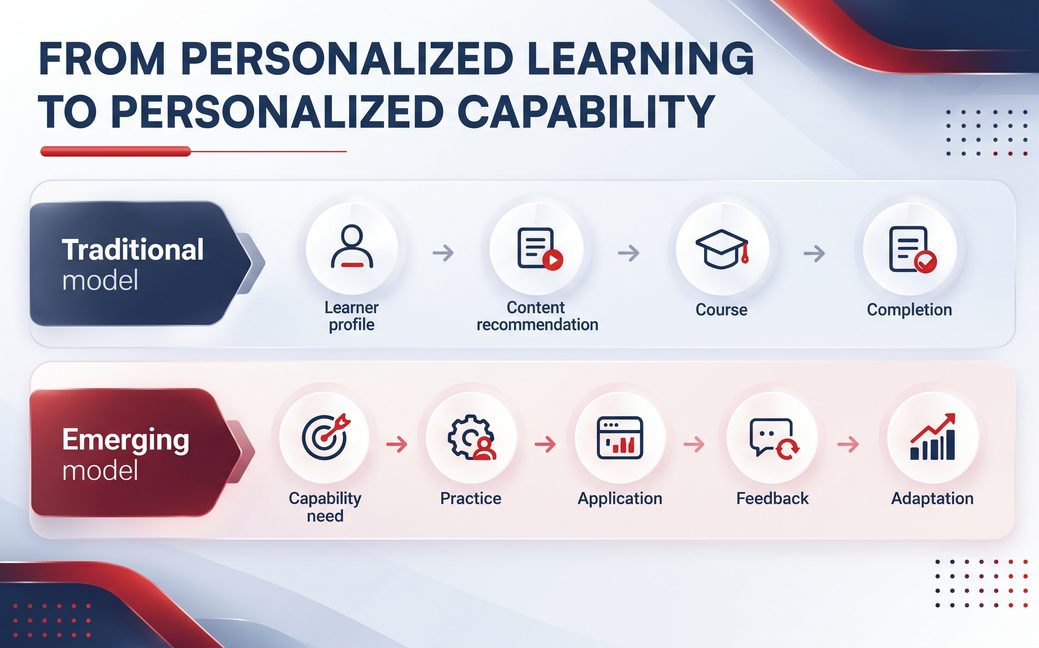
The first model personalizes consumption. The second personalizes development. For organizations, the bigger question is whether that personalization leads to demonstrated performance. That changes what personalization should optimize for.
Practice may be the next frontier of personalization
A course recommendation starts with the question, “What should this person learn next?” Capability development starts further upstream: “What does this person need to perform better?”
Answering this requires richer signals: current proficiency, role expectations, performance gaps, work context, prior experience and signals generated through everyday work. That also changes what we personalize. Instead of personalizing around courses, we can focus on capabilities such as negotiation, decision-making or using emerging technology effectively.
I saw this distinction recently in a conversation with a professional certification organization. We started by talking about improving learning content. The conversation quickly moved to a harder question: How do we help candidates identify what they still need to practice?
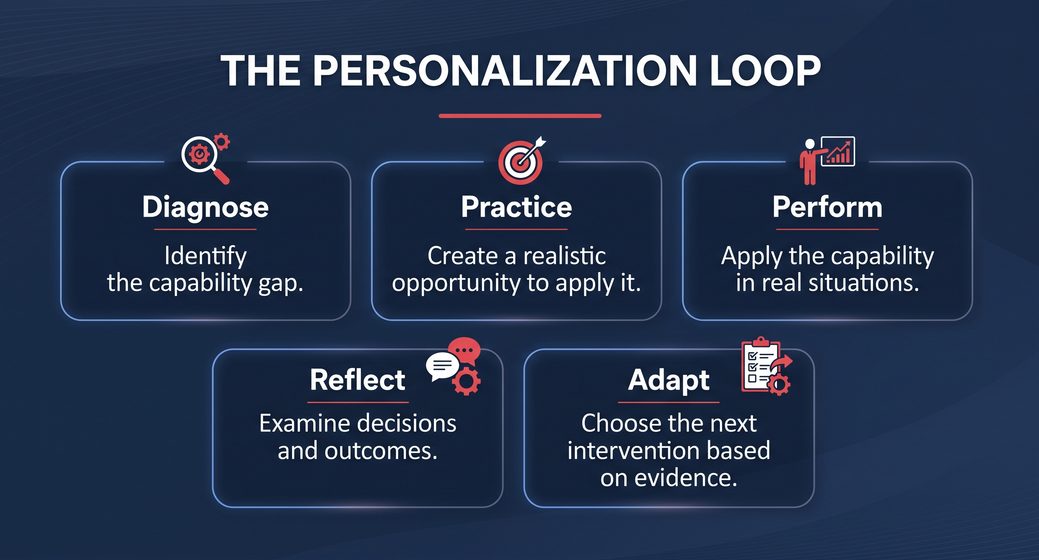
More content was not the answer. They needed a way to diagnose gaps, practice against those gaps, receive feedback and build confidence before the assessment.
A similar pattern comes up in leadership development. Knowing the principles of a difficult conversation is very different from navigating one. An AI-enabled practice environment can let a manager rehearse that conversation, respond to an employee who reacts unexpectedly and receive feedback on what happened.
In that setting, personalization could mean knowing what to practice next rather than simply receiving another module recommendation.
If the aim is stronger performance, people need opportunities to practice the skills they are expected to use. Development becomes an ongoing process: people practice a skill, apply it, receive feedback, improve and practice again.
AI can make this process easier to scale. Managers, coaches and subject-matter experts still play an important role, however. They provide judgment, accountability and developmental relationships that technology cannot fully replicate.
AI can also support different parts of the process in different ways. During practice, it can adjust the scenario, complexity and context. During performance, it can provide contextual support where appropriate. Afterward, it can analyze decisions and help determine whether someone needs more learning, practice, coaching, or real-world application.
Some capabilities simply require more than explanation. Judgment, negotiation, coaching and decision-making develop through making choices, seeing consequences and adjusting. That is why practice becomes so important.
There is another implication worth considering.
Sometimes the best personalized learning decision may be no learning intervention at all. If someone can already demonstrate the capability, the system should recognize that and get out of the way. An opportunity to apply the capability may be more useful than another course.
 Originally published at https://www.chieflearningofficer.com/2026/10/21/beyond-personalized-learning-capability-development-requires-more-than-ai-recommendations/