Organizations have adopted artificial intelligence at unprecedented speed. Few have yet to see it change how work gets done.
The gap is not technical; it is adaptive. For chief learning officers, the question is less about how to implement AI, but rather how to help people adapt alongside it.
The AI adoption paradox
Over the past two years, AI has moved through organizations faster than any workplace technology in memory. By late 2025, McKinsey & Company reported that nearly nine in 10 organizations used AI regularly in at least one business function.
While enthusiasm leads, returns lag. Drawing on more than 300 enterprise deployments, MIT’s Project NANDA revealed that roughly 95 percent of generative AI pilots produced no measurable profit-and-loss impact.
While this could point to a pilot-to-production problem, MIT NANDA researchers suggest this is a learning gap: tools were adopted, but learners did not meaningfully change how they worked. Success, they concluded, hinges on the approach and not the technology.
Harvard leadership researchers introduced the adaptive leadership framework to emphasize the idea that change is the norm in organizations. Adaptive leadership distinguishes between technical challenges, which can be solved with existing expertise and adaptive challenges, which requires people to learn, adjust and change their behavior.
Organizations that treat AI as a technical challenge miss how it alters professional identity, redistributes expertise, blurs accountability and raises pressing questions about who benefits and takes on risk.
Leader mindsets and AI adoption
AI adoption skills depreciate as fast as tools change. Mindsets are the built capacity leaders need for the AI era. A leader’s mindset determines whether they see AI as a threat to control, a lever for headcount reduction or an opportunity to redesign work around human strengths. This mindset also mediates how AI is experienced by people in the leader’s organization.
The learning remit must transcend AI training to build a responsive learning ecosystem in which people can openly question outputs, develop judgment, practice new ways of working, preserve essential expertise, create new trust norms and participate in redesigning work.
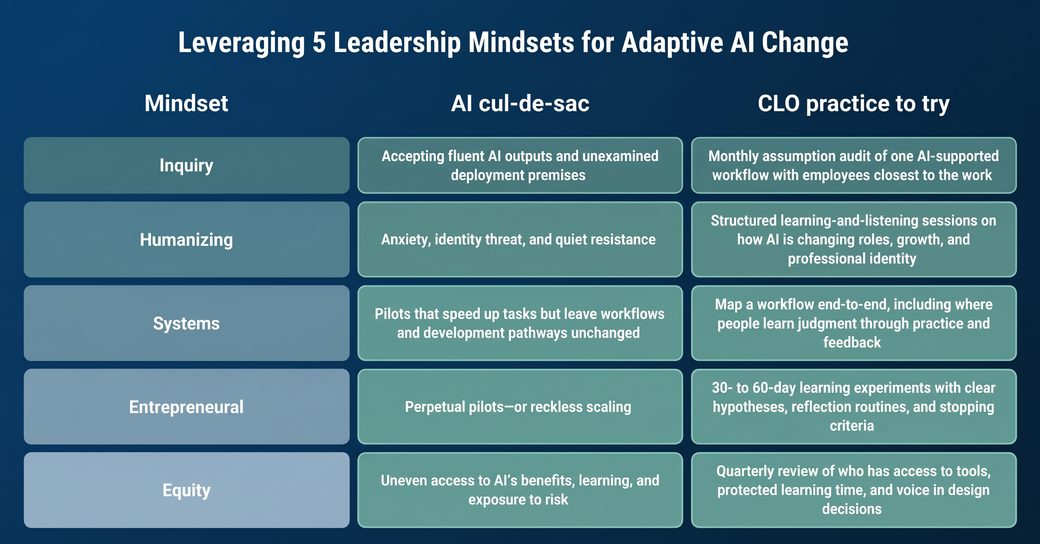
The Flux 5 is a leadership framework built around five mindsets: Inquiry, humanizing, systems, entrepreneurial and equity. Together, they help leaders move from AI adoption—and avoid getting stuck in the figurative AI cul-de-sac—to adaptive workforce development.
1. Inquiry Mindset: Question the output and the premise
An inquiry mindset—an intentional learner stance committed to questioning norms and surfacing invisible organizational logics—becomes an essential safeguard in an information environment prone to err. Inquiry in the AI era operates at two levels: the output: building the habit of and flows around interrogating AI production, and the premise: examining assumptions embedded in AI-specific decisions. What problems are we solving? Whose priorities are driving this use case? What will change once this process is automated?
For CLOs, this means moving from AI training to work-embedded learning. Employees learn by comparing AI outputs with expert judgment, verifying claims against trusted sources, identify misses and sharing observable patterns, ultimately building disciplined discernment, a capability more valuable than prompt fluency alone.
Key practices
AI assumption audits: Each month, select one AI-supported decision or workflow and generate authentic spaces of dialogue: What does this tool assume about our [work/clients/customers/people]? What would we see differently without it?
Rapid-cycle inquiry on adoption: Use short listening cycles such as flash focus groups and brief pulse questions to surface how employees are using AI, where it helps and where they are working around it.
Judgment labs: Use real work artifacts to help teams compare AI output with expert analysis, identify errors or missing context and articulate indispensable human judgment.
2. Humanizing mindset: Hold people through the transition
AI anxiety is widespread, and it is rational. Employees are being asked to adopt tools that may reshape or eliminate parts of their roles, often without clarity about organizational intent. When leaders frame AI as a productivity lever, distrust mounts—through knowledge blocking, minimal compliance and silent resistance. A humanizing mindset centers people, purpose and presence, asking leaders to attend to the relationship between technology and professional identity.
For CLOs, this me