
On 17 September 2026, Prof. Rob Briner, Associate Research Director at CRF, and Johannes Sundlo, Founder of Prorio AI, launched CRF’s AI in HR Series with its opening webinar, Where Does AI Really Create Value?
AI is already changing how work gets done, and the pressure to act is intensifying. New tools arrive almost daily, and the temptation is to move quickly simply to avoid falling behind. But speed is not progress. Organisations must determine where AI will improve something that matters, where it may create new risks and where human judgement must remain central.
HR has a decisive role to play. It does not need to become the technology expert, but it must help the business make better choices about how work should change, what people will need to succeed and where AI genuinely belongs. Through events, practical learning and research, CRF’s AI in HR Series will help HR turn experimentation into business value.
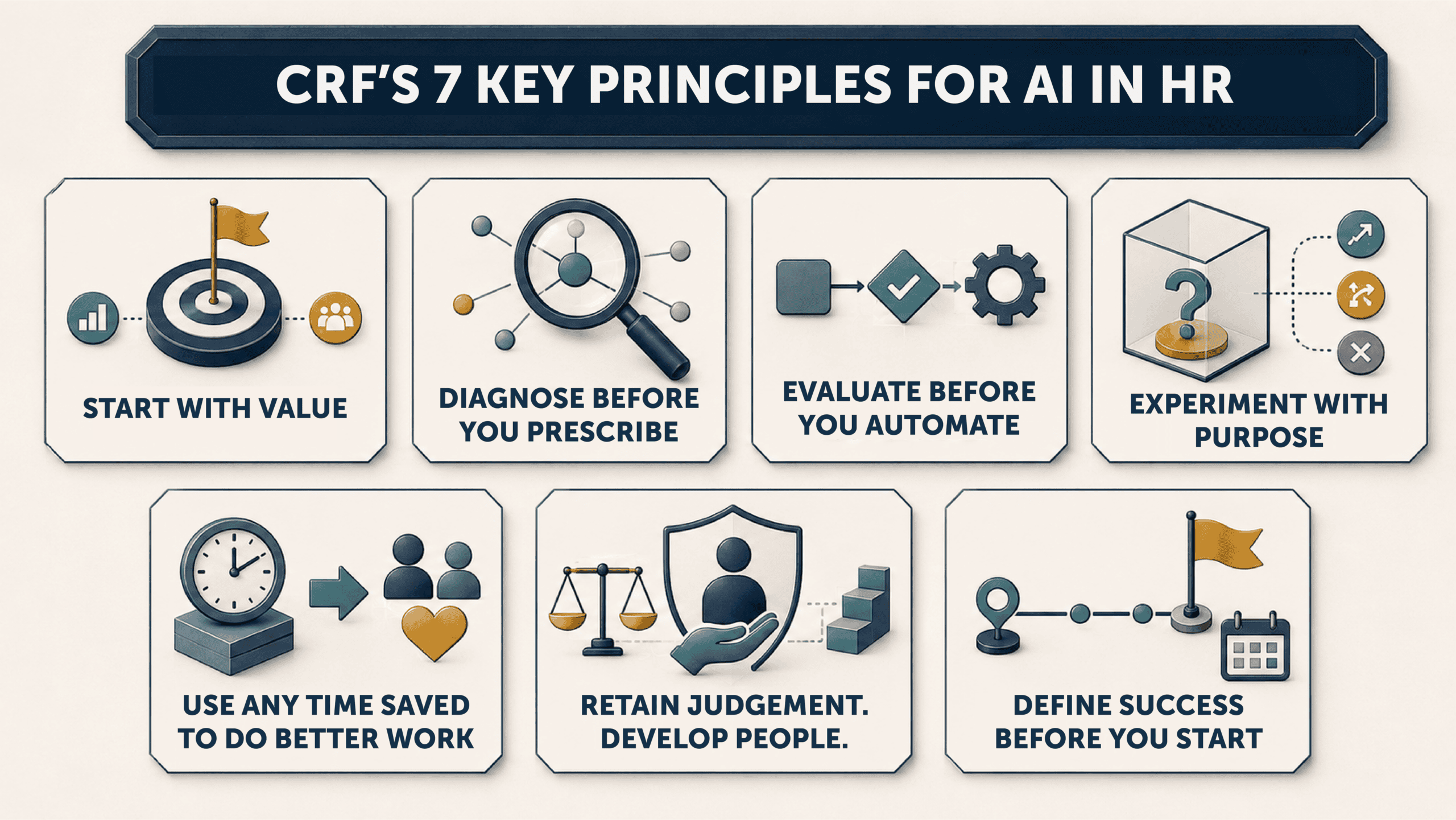
Seven principles for making better decisions about AI
The webinar centred on CRF’s recently published Seven Key Principles for AI in HR. Designed to cut through the hype and urgency surrounding AI, they replace the question “How can we use it?” with a more demanding one: “Where will it create value?”
These are not instructions for choosing tools. They provide a practical framework for deciding when, where, why and how AI should be used. They help organisations avoid automating work that should be redesigned, treating time saved as value and allowing human capability to weaken in pursuit of efficiency.
Explore CRF’s Seven Key Principles for AI in HR to understand the thinking behind each principle and consider the practical questions that can help your team put them into action.
Five key takeaways
The discussion made one point unmistakably clear: adopting more AI will not automatically create more value. These five lessons can help HR make choices that improve work rather than simply accelerate it.
1. Value begins with the outcome, not the technology
Too many AI initiatives begin with a tool in search of a problem. The better starting point is the outcome the organisation needs to improve and the barriers currently standing in its way.
Consider onboarding. Is the aim to help new employees contribute sooner, improve their experience or increase retention? Each is a different problem and may require a different response. Until the intended outcome is clear, an organisation cannot know whether AI is the right intervention or judge whether it has worked.
2. Sometimes the fastest route to value is to slow down
AI can make a process faster without making it any better. Before automating something, organisations should ask whether the process is necessary, whether it works and whether it contributes to an outcome that matters. A poor process should be removed or redesigned, not accelerated.
Experimentation also needs discipline. Testing AI can build familiarity, but useful experiments begin with a clear question and a defined measure of success. What works can be scaled. What shows promise can be adapted. What adds no value should be stopped.
3. Individual productivity does not guarantee organisational performance
AI may help someone finish a task more quickly. That does not mean their team or function will perform better. Work is interconnected. Changing one task can move work elsewhere, create new demands for colleagues or disrupt the way roles fit together.
A Swedish public body tackled this challenge by bringing senior leaders and employees together for five AI learning sessions over three months. Rather than imposing a strategy from above, leaders built a shared understanding of where AI supported the organisation’s purpose and where it did not. One application that followed used AI to triage incoming claims, significantly reducing response times.
4. Time saved is a resource, not a result
A shorter task is not, by itself, a better business outcome. Value depends on what happens to the capacity AI releases.
One organisation automated much of the administration involved in supporting employees working on visas. It then moved two employees from processing paperwork to providing visa holders with more personal support. Engagement among this group increased. The value did not come from saving time alone, but from consciously reinvesting it in work that mattered more.
This is a choice organisations must make in advance. Otherwise, promised efficiencies may never translate into better performance.
5. More AI makes human judgement more valuable
AI can produce polished and convincing work at speed. That does not make the output reliable, appropriate or correct. As adoption grows, employees will need to question what AI produces, spot errors and know when to accept, revise or reject its conclusions.
Managers must set clear expectations for the quality and accountability of AI-assisted work.
Judgement also means noticing what efficiency removes. One geographically dispersed organi